7 steps to learn forex trading from scratch
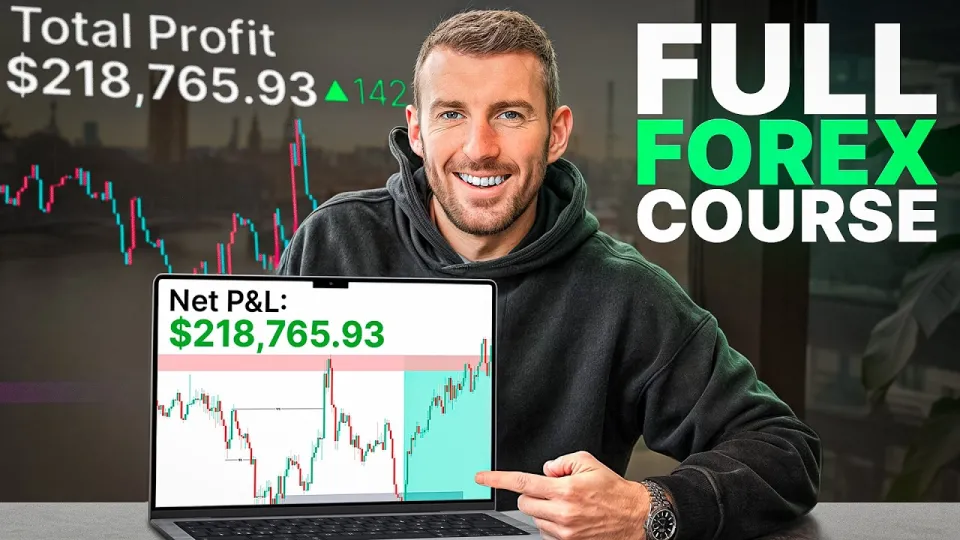
Video: Beginners Guide To Forex Trading In 2026 (+3 hours)
Need articles like this for your video? They help promote it on YouTube and Google — order them in the Telegram bot @sat_sit_bot. It writes articles around your video, embeds the video and publishes them on popular niche websites (no ads). Your first 50 articles are free.
· based on the channel Matt Donlevey - Photon Trading
Key takeaways
- Forex is a decentralized market where currencies trade in pairs; daily volume exceeds $7 trillion.
- Most retail traders lose money due to poor risk management and lack of a tested strategy.
- A complete trading plan includes entry/exit rules, position sizing, and a journal.
- Market structure, supply and demand, and liquidity are core concepts for price action trading.
- Photon Trading offers a free beginner course with cheatsheets to accelerate learning.
Forex trading is the practice of speculating on currency price movements in the world's largest financial market, where daily turnover exceeds $7 trillion. To start, beginners should focus on understanding market structure, risk management, and trading psychology rather than chasing indicators. A structured approach, like the one outlined in Matt Donlevey's free Photon Trading course (available here), can shorten the learning curve significantly.
1. Understand what forex is and how it works
Forex (foreign exchange) is a decentralized global marketplace where national currencies are traded in pairs, such as EUR/USD or GBP/JPY. Unlike stocks, there is no central exchange; trading occurs over-the-counter between banks, institutions, and retail brokers. The forex market operates 24 hours a day, five days a week, across major financial centers like London, New York, Tokyo, and Sydney. Currency values fluctuate based on interest rates, economic data, geopolitical events, and supply and demand. Retail traders typically access the market through brokers offering leverage, which amplifies both potential profits and losses.
2. Learn the basics of market dynamics and order flow
Price movement is driven by the interaction of buyers and sellers in the order book, not by geometric patterns. Understanding market microstructure—bid, ask, spread, and order flow—helps you see why price moves. Auction market theory explains that markets seek fair value by balancing supply and demand; when one side becomes aggressive, price trends. Order flow analysis, which tracks the volume and direction of trades, reveals where large players are active. This foundation allows you to build a strategy based on real market logic rather than arbitrary chart shapes.
3. Master technical analysis and chart reading
Technical analysis involves studying historical price data to forecast future movements. Candlestick charts are the primary tool, showing open, high, low, and close prices for each period. Key concepts include support and resistance, trendlines, and chart patterns. However, Matt Donlevey emphasizes that technical analysis alone is insufficient; it must be combined with an understanding of market structure. Market structure refers to the sequence of higher highs and higher lows (uptrend) or lower highs and lower lows (downtrend). Identifying structure shifts—such as breaks of structure or changes of character—helps you spot potential reversals. Premium and discount zones, derived from Fibonacci retracements, indicate whether price is relatively expensive or cheap within a range.
4. Develop a trading strategy with clear rules
A trading strategy is a set of rules that define entry, exit, and risk management. Start by choosing a timeframe that suits your lifestyle—day trading, swing trading, or position trading. Then, define the conditions for entering a trade: for example, a break of structure combined with a retest of a supply or demand zone. Supply and demand zones are price levels where institutional orders are likely clustered. Liquidity concepts, such as stop hunts and liquidity pools, explain why price often reverses at obvious levels. Your strategy should include multi-timeframe analysis: use a higher timeframe to determine the trend and a lower timeframe to time entries. Backtest your strategy on historical data to verify its edge before risking real money.
5. Implement strict money management and risk control
Money management determines how much capital you risk per trade. A common rule is to risk no more than 1–2% of your account on any single trade. Position sizing is calculated based on the distance between your entry and stop-loss, ensuring that a losing streak does not wipe out your account. Trading costs—spreads, commissions, and swaps—also affect profitability; choose a broker with transparent pricing and regulation. Matt Donlevey highlights three common mistakes: overleveraging, moving stop-losses, and revenge trading. A trade journal helps you track performance, identify patterns, and refine your approach. Trading psychology is equally important: master the strategy first, then work on discipline and emotional control.
6. Choose a broker and execute your first trades
Selecting a regulated broker is critical. Look for oversight from authorities like the FCA, ASIC, or CySEC, and ensure the broker offers a demo account for practice. Execution involves placing market or pending orders with defined stop-loss and take-profit levels. Start with a small live account to experience real market conditions without risking significant capital. Keep a detailed journal of every trade, including the rationale, outcome, and emotions. Review your journal regularly to spot strengths and weaknesses. As you gain confidence, gradually increase position size while adhering to your risk rules.
7. Avoid common pitfalls and build a long-term plan
Most beginners fail because they lack a structured plan. Avoid jumping between strategies, overtrading, and ignoring risk management. Create a written trade plan that outlines your goals, risk parameters, and daily routine. Backtest and forward-test your strategy until you have consistent results. Understand that trading is a skill that takes time to develop—expect to spend months in simulation before going live. Matt Donlevey's 3-hour beginners guide on the Photon Trading channel provides a comprehensive walkthrough of these concepts, from market microstructure to trade journaling. The accompanying free course and cheatsheets can further accelerate your progress.
Useful links
- Free Photon Trading Course + Cheatsheets
- Photon Trading Mentorship
- Telegram Channel
- Instagram @photontrading
Bottom line
Learning forex trading requires a systematic approach that combines market understanding, technical skills, and psychological discipline. Start with a solid foundation in market dynamics and structure, then develop a rules-based strategy and backtest it thoroughly. Prioritize risk management and keep a journal to track your growth. Matt Donlevey - Photon Trading offers a free, in-depth course that covers everything from order flow to trade execution, making it an excellent starting point for beginners. Remember that consistency and patience are key to long-term success.
Don't forget to grab your free course and cheatsheets here: https://www.photontradingfx.com/free-training?el=beginnersguide&htrafficsource=YT.
Questions & answers
How much money do I need to start forex trading?
You can start with as little as $100 with a micro account, but it's recommended to have at least $1,000–$5,000 to properly manage risk. Many brokers offer demo accounts to practice without real money. Focus on learning first, then gradually increase capital.
Is forex trading profitable for beginners?
Profitability requires a proven strategy, strict risk management, and psychological discipline. Most beginners lose money initially, so treat it as a skill-building process. With consistent practice and a solid plan, it's possible to become profitable over time.
What is the best strategy for forex trading?
There is no single best strategy; it depends on your personality and schedule. Many traders use market structure, supply and demand, and liquidity concepts to identify high-probability entries. The key is to backtest and refine a strategy that fits your risk tolerance.
Do I need to understand order flow to trade forex?
While not mandatory, understanding order flow and market microstructure gives you a deeper insight into price movements. It helps you see why price reacts at certain levels and can improve your decision-making. Many successful traders incorporate order flow analysis into their approach.
Source: Beginners Guide To Forex Trading In 2026 (+3 hours) · Markdown version